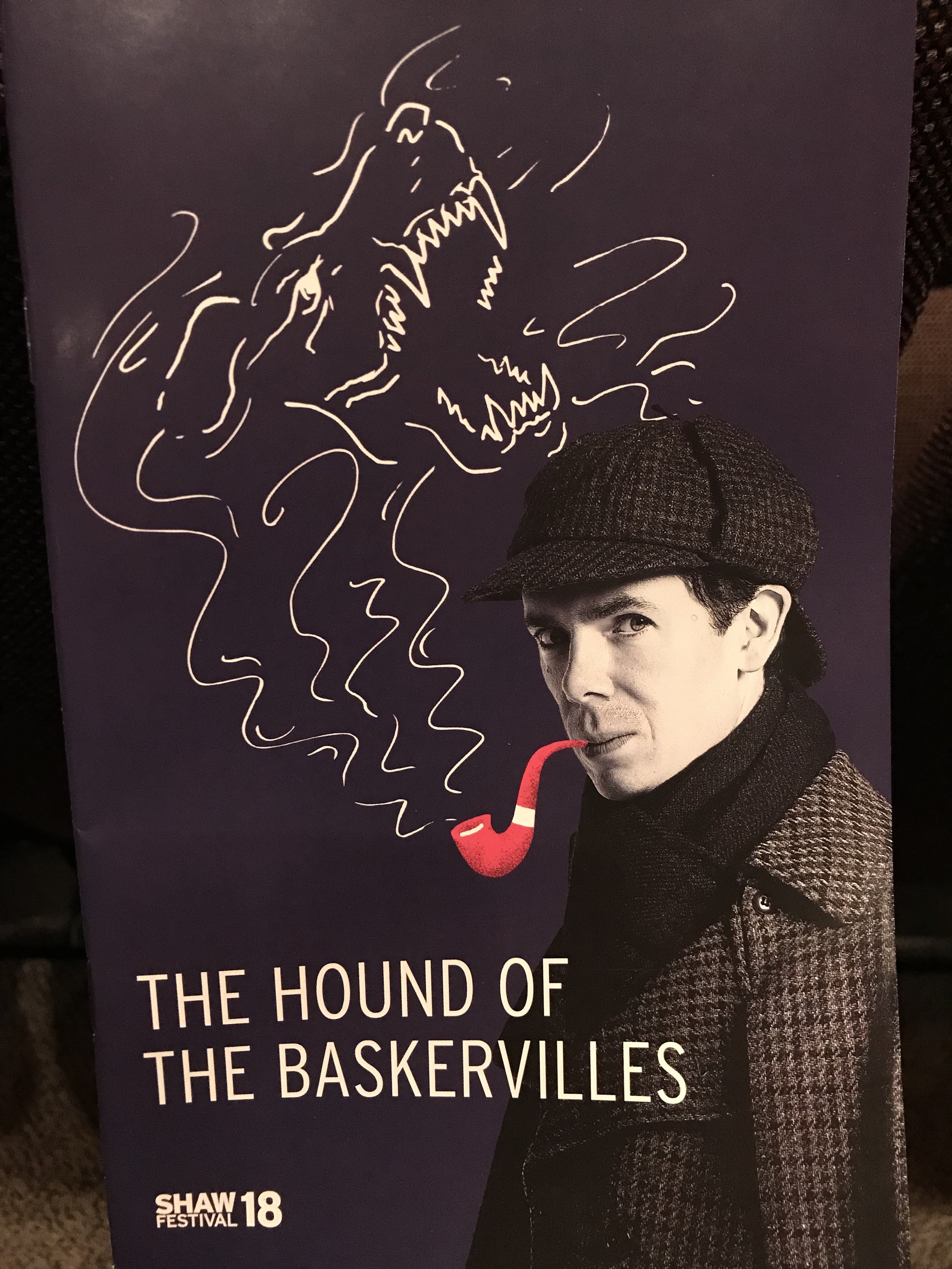

On Sunday October 21st, I went to go see The Hound of the Baskervilles adapted by R. Hamilton Wright and David Pichette and directed by Craig Hall at the Shaw Theater in Niagara-on-the-Lake. And what a show! If you haven’t seen the stage play then you must! Absolutely everything—from the performance; to the visual and sound effects; to costumes and to props—the play brought to life the world of Sherlock Holmes as depicted in Doyle’s story, however, with a twist ending. I was impressed by how almost each cast member played more than one role. Actor Damien Atkins who played the role of Sherlock Holmes, as well as the man on the Tor and the reverend, executed his performance with finesse. Specifically, his reinterpretation of Sherlock Holmes’s character brought humor, wit and a little more madness than expected. In Act III, during Holmes’s and Watson’s debriefing over breakfast, Holmes stuffed his face with bacon and to my relief he didn’t choke on any of it. In fact, I was surprised to see that food and drinks were actually consumed on stage. Ric Reid’s performance of Watson was equally brilliant. Often, Watson’s role in other adaptations is severely undermined as he is rendered as Holmes’s comic foil but the play reminded me of just how important Watson’s presence is in the story. He is a caring doctor, a clever “spy,” and a friend who carries out Holmes’s plans with honor. My favorite line in the play by Watson was: “The Game is afoot! I’ve always wanted to say that!” which is obviously not mentioned in the novel—at least to my knowledge.
While there are many other memorable moments in the stage play, the ending struck a chord with me as it took a radical departure from Doyle’s original story…
Here come the spoilers! You’ve been warned. Dun Dun Dun!
In Doyle’s The Hound of the Baskervilles, Jack Stapleton is the criminal mastermind behind a double murder, and the one who devises a plot to murder Sir Henry who stands in his way of inheriting the Baskerville fortune. Although his plan is ultimately intercepted by Holmes, Jack goes to great lengths to achieve his goal. Specifically, he uses women as pawns in his own game, deceiving, for example, Laura Lyons with the promise of marriage when he is already married to Beryl, a Costa Rican woman he met during his travels in South America. Beryl, however, initially appears in the story as Jack Stapleton’s sister, which was contrived by Jack himself as part of his scheme.
Throughout the story, readers aren’t given much information about Beryl other than facts about her physical appearance. According to Watson, “she was darker than any brunette whom I have seen in England—slim, elegant, and tall.” Like in other stories, Watson doesn’t fail to remind us of his attraction to women. Often women in the Canon are limited to the following roles: they appear as helpless damsels-in-distress, victims of folly, murder, or are utilized as a mere plot device. Of course, Irene Adler stands as the only exception. In the novel, Beryl is physically and emotionally abused by Jack who eventually locks her up at the end of the story in fear that she will jeopardize his plans. She is eventually rescued by Holmes, Watson and Lestrade. The scene in the novel is described as follows:
The room had been fashioned into a small museum, and the walls were lined by a number of glass-topped cases full of that collection of butterflies and moths the formation of which had been the relaxation of this complex and dangerous man. In the centre of this room there was an upright beam, which had been placed at some period as a support for the old worm-eaten baulk of timber which spanned the roof. To this post a figure was tied, so swathed and muffled in the sheets which had been used to secure it that one could not for the moment tell whether it was that of a man or a woman. One towel passed round the throat and was secured at the back of the pillar. Another covered the lower part of the face, and over it two dark eyes—eyes full of grief and shame and a dreadful questioning—stared back at us. In a minute we had torn off the gag, unswathed the bonds, and Mrs. Stapleton sank upon the floor in front of us. As her beautiful head fell upon her chest I saw the clear red weal of a whiplash across her neck.
“The brute!” cried Holmes. “Here, Lestrade, your brandy-bottle! Put her in the chair! She has fainted from ill-usage and exhaustion.”
She opened her eyes again.
“Is he safe?” she asked. “Has he escaped?”
“He cannot escape us, madam.”
“No, no, I did not mean my husband. Sir Henry? Is he safe?”
“Yes.”
“And the hound?”
“It is dead.”
She gave a long sigh of satisfaction.
“Thank God! Thank God! Oh, this villain! See how he has treated me!” She shot her arms out from her sleeves, and we saw with horror that they were all mottled with bruises. “But this is nothing—nothing! It is my mind and soul that he has tortured and defiled. I could endure it all, ill-usage, solitude, a life of deception, everything, as long as I could still cling to the hope that I had his love, but now I know that in this also I have been his dupe and his tool.” She broke into passionate sobbing as she spoke.
—Sir Arthur Conan Doyle, The Hound of the Baskervilles, Project Gutenberg
This passage creeps me out! Readers aren’t told about what happens to Beryl after this ordeal. All that matters, I suppose is that the sadistic psycho, Jack Stapleton, met his end (it’s suggested that he fell into a mire as he fled towards his hideout), and Beryl will never again be a victim of his jealous rage. And, so the story concludes on a very happy note with Holmes and Watson getting ready to embark on their next adventure. Hip hip hooray for our heroes!